


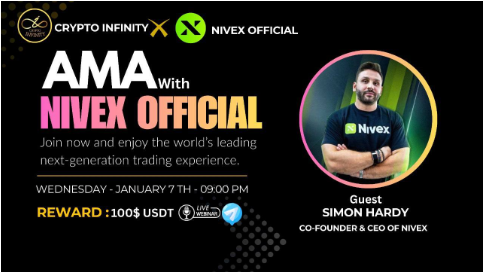
On January 7, 2026, an AMA titled "AMA – CRYPTO INFINITY <> Nivex_Official | REWARD $100" was held, featuring Simon V. Hardy, Co-Founder and CEO of Nivex, together with the Crypto Infinity team. The discussion covered AI-driven trading, futures risk control, asset-listing logic, incentive mechanisms, and long-term user value. Key takeaways include:
1. The core issue in crypto trading is not a lack of features, but fragmented decision-making and risk logic.
Simon noted that traders are often forced to move between exchanges, wallets, and yield products, with no unified framework for risk management or decision-making. Nivex's goal is not to simply add more features, but to integrate AI execution, institutional-grade strategies, and automated risk management into a single, unified trading environment.
2. Platform design prioritizes preventing early elimination of beginners rather than optimizing for professionals.
Nivex believes most traders experience losses in their first two to three years. As a result, the platform focuses less on maximizing efficiency for seasoned traders and more on reducing learning and trial-and-error costs for new users-by simplifying the front-end while preserving an institutional-grade core engine.
3. AI and copy-trading mechanisms allow beginners to learn without inevitably losing money.
The team explained that new users can directly access copy trading, fixed-investment plans, and AI-assisted strategies without complex parameter settings. Beginners and professional users share the same underlying trading engine, enabling learning and income generation to occur in parallel.
4. Asset-listing decisions are driven by "risk-adjusted liquidity," not market hype.
Simon emphasized that after observing recent market cycles, the platform has become far more selective. Listing criteria focus on sustainable market depth, derivatives liquidity, performance under extreme conditions, and manipulation risk-rather than short-term trends or speculative sentiment.
5. The futures system is designed for extreme market conditions from day one, not ideal scenarios.
Nivex's futures engine assumes high volatility as the norm. Through dynamic margin recalculation, multi-layer liquidation buffers, AI-based position control, and strategy-level staged stop-loss mechanisms, the platform aims to reduce cascading liquidations. The team stressed that the core objective is drawdown control, not maximum leverage.
6. AI trading is not based on fixed rules, but on continuous adaptation.
The team differentiated traditional quantitative bots from adaptive AI strategies. Unlike static rule-based systems, Nivex's AI continuously adjusts to bull and bear cycles, volatility shifts, liquidity structures, and participant behavior.
7. Copy trading emphasizes risk transparency rather than headline returns.
Instead of highlighting short-term profit rankings, Nivex prioritizes metrics such as historical drawdowns, volatility, trading frequency, average holding time, and risk classification-encouraging users to choose strategies aligned with their capital size and risk tolerance.
8. Long-term investment products aim to absorb decision-making burden on behalf of users.
For users who prefer not to monitor markets constantly, Nivex offers dollar-cost averaging, yield products, and institutional-grade strategy combinations, reducing daily decision pressure while enabling continued market participation.
9. Security is treated as infrastructure, not a marketing feature.
Simon stated that Nivex approaches security as a system-level discipline. Through hot-cold wallet separation, multi-signature custody, AI-driven risk monitoring, compliant KYC/AML frameworks, and ongoing third-party audits, the platform seeks to ensure long-term operational stability.
10. Incentive mechanisms are designed for long-term participation, not short-term reward extraction.
The team explained that rewards are tied to real trading behavior, volume, and activity, and are released in stages. This structure discourages "reward-and-leave" behavior and encourages sustained engagement with the platform's products and services.
11. Nivex's differentiation lies not in tools, but in "decision intelligence."
Simon concluded that while traditional exchanges primarily offer trading tools, Nivex aims to deliver decision-layer capabilities-continuously providing trading approaches that work under current market conditions, rather than relying on strategies that succeeded in the past.

所有评论