

This is not a peaceful era. From the Russia-Ukraine conflict to the U.S.-Iran war, the world is undergoing a global contest centered on dollar hegemony and the debt crisis. The Russia-Ukraine conflict has driven European capital to continue flowing back to the United States; the U.S.-Iran war has pushed up international oil prices and global inflation. War, energy, inflation, interest rates, and global capital flows may seem independent of one another, but in fact they are connected by the same core variable — the ever-expanding U.S. national debt.
According to data released by the U.S. Treasury in mid-May, the scale of U.S. federal debt has exceeded 39 trillion dollars. For the United States, debt is no longer merely an economic issue, but a core issue related to the credibility of the dollar, the stability of the financial system, and the leading position in the global order.
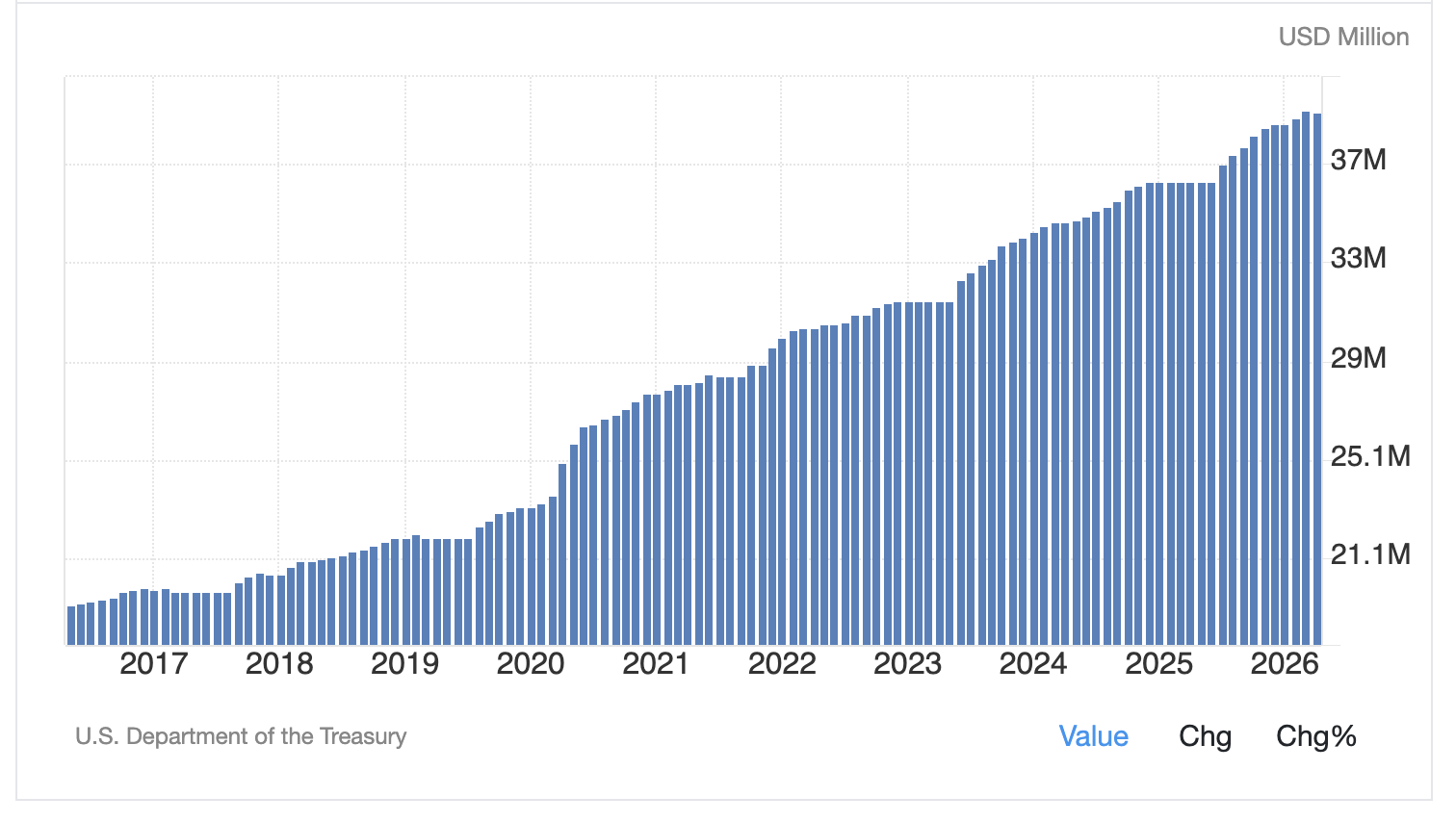
(Note: U.S. federal debt scale)
Economist Hyman Minsky proposed the famous “Minsky moment” theory: in a long period of prosperity and stability, market participants tend to become increasingly optimistic and continuously expand leverage and debt. When debt expansion exceeds the system’s capacity, any external shock may become the last straw that breaks the market. The 2008 U.S. subprime mortgage crisis is a classic example of a “Minsky Moment.”Against the backdrop of continued rises in real estate prices, a large number of financial institutions kept increasing leverage and expanding credit, eventually causing concentrated risk explosions and triggering a global financial crisis.
Today, more and more investors are beginning to notice that the global economy is showing signals similar to those of that period: debt levels continue to rise, asset prices remain high for long periods, geopolitical risks keep accumulating, and the global monetary system is under adjustment pressure. Of course, this does not mean that the 2008 crisis will certainly repeat itself.
But when U.S. debt breaks through 39 trillion dollars and leverage levels in the global financial system continue to climb, the market must begin to consider a question: are we approaching a new “Minsky moment”? Whether the answer is yes or no, risk expectations have already begun to spread through global markets. Against this backdrop, the sharp volatility in core assets such as gold, crude oil, and Bitcoin may not be accidental, but rather an advance response by capital to future uncertainty.
An Era of Uncertainty and High Volatility
As mentioned above, the global market is entering an unprecedented period of uncertainty. For investors, the real question may no longer be where the next opportunity lies, but rather: in an era of uncertainty and high volatility, are the investment logics we used to know still effective?
For a long time in the past, the Old Money investment logic represented by Warren Buffett dominated global capital markets. Study a company, study an industry, then hold for the long term and wait for growth and value realization. This logic was built on a relatively stable era. Globalization kept advancing, the international order was relatively stable, and the monetary system operated in a predictable way. The market’s long-term trend was driven more by corporate fundamentals.
But today, the core variables affecting the market are changing profoundly. Interest rate policy, debt problems, tariff adjustments, energy supply, war conflicts, and geopolitical risks are increasingly affecting market pricing. Many times, a news item, an economic data release, a policy statement, or even a sudden event can trigger sharp movements in assets such as gold, crude oil, and Bitcoin in a short period of time.
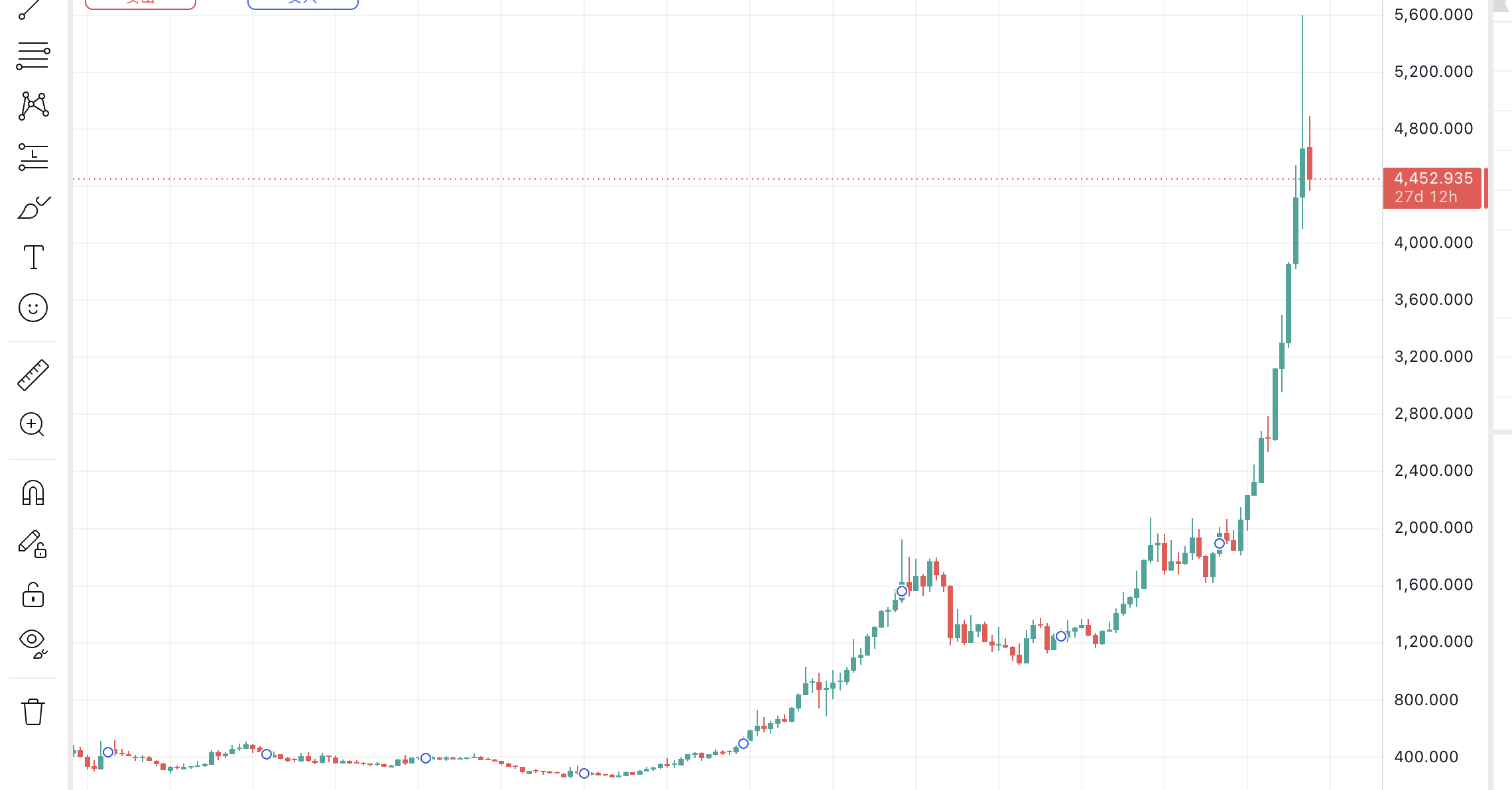
(Note: gold candlestick chart)
The market is gradually shifting from the relatively stable “fundamentals-driven” model of the past to a more sensitive “expectations-driven” one. The challenge facing investors has also shifted from finding quality assets to figuring out how to respond to a constantly changing market environment. Because when the market cycle shortens from “months” to “weeks,” or even “hours,” what investors need is no longer only long-term holding ability, but also the ability to understand the market faster and respond to changes faster.
Event Contracts: When Volatility Becomes an Opportunity
In such a market environment, volatility itself is becoming a new source of opportunity. In the past, investors relied more on long-term asset appreciation for returns; today, many market opportunities are born the moment price volatility occurs. An upside surprise in non-farm payroll data, a geopolitical conflict, a tariff policy adjustment, or even a speech by a central bank official may quickly drive noticeable volatility in assets such as gold, crude oil, and Bitcoin.
The market is becoming harder to predict, yet more full of trading opportunities. So for investors, the question is how to make quick judgments and seize opportunities when market changes occur. When gold rises, crude oil falls, or BTC breaks through a key level, is there a simpler and more direct way to participate?
BitradeX provides the perfect answer — Event Contracts. Compared with traditional contract trading, Event Contracts place greater emphasis on a simple, intuitive, and lightweight trading experience. Users do not need to study complex leverage mechanisms, nor do they need to deal with professional parameters such as margin management and forced liquidation price calculations.
The trading logic returns to the most essential question: will the market rise or fall? Users only need to make a market judgment and choose Call or Put to participate in market movements. When the market outcome matches the prediction, users can obtain the corresponding return; if the judgment is wrong, they only lose the contract amount paid at the time of order placement. Compared with traditional contract trading, Event Contracts are better suited to participating around market volatility itself rather than being constrained by complex rules.
At present, BitradeX Event Contracts support popular trading assets such as gold (XAUTUSDT), crude oil (CLUSDT), BTC/USDT, and ETH/USDT. Whether it is gold movements driven by geopolitical changes, crude oil volatility brought by shifts in energy supply and demand, or opportunities in BTC and ETH during crypto market cycles, users can participate in the market in a simpler and more intuitive way.
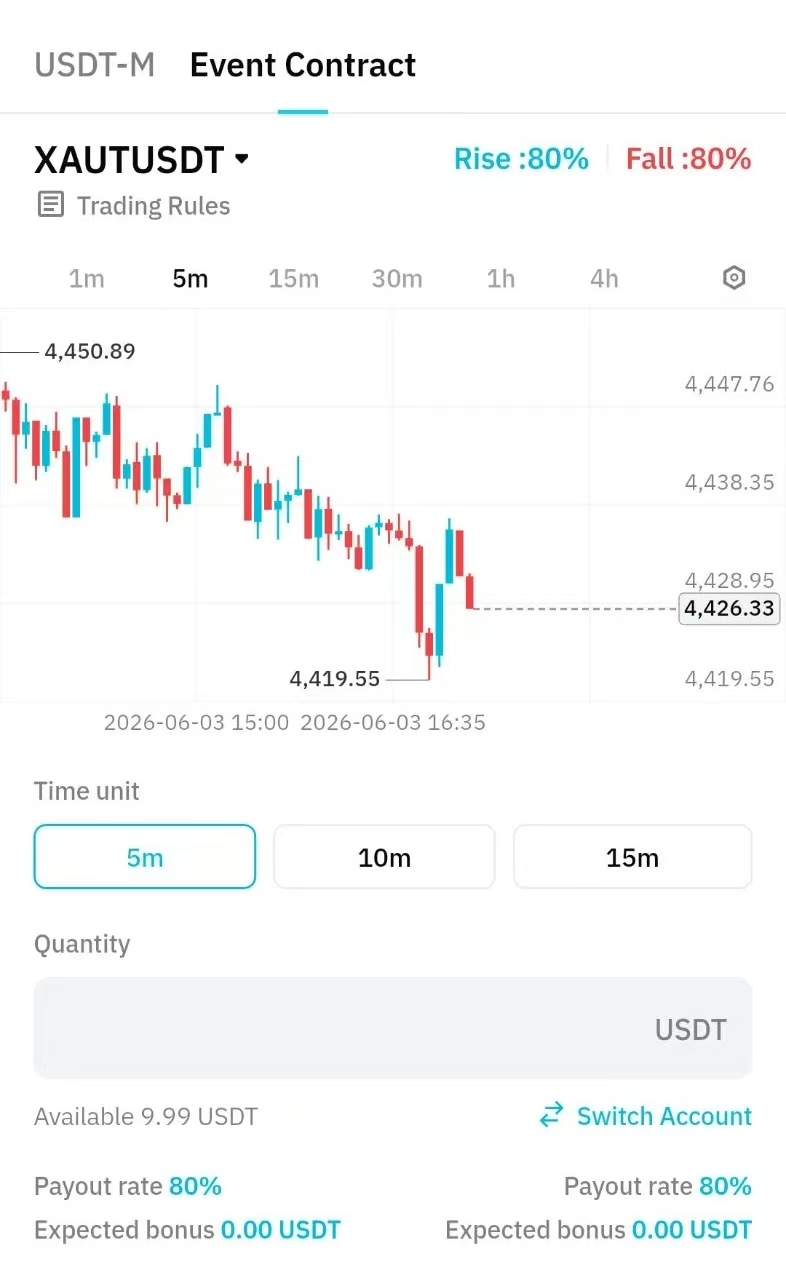
(Note: BitradeX Event Contracts page)
At the same time, the platform offers multiple trading durations such as 5 minutes, 10 minutes, and 15 minutes, helping users capture market rhythm more flexibly. In today’s increasingly volatile market, opportunities often come and go quickly. Shorter trading durations also allow investors to respond to market changes more rapidly.
Note: In essence, this type of product is a derivative tool based on market direction judgment and is suitable for users who can assess short-term volatility.
volatility Is Becoming the New Normal in the Market
Looking back at global economic development over the past few decades, the market’s biggest feature was growth. Today, however, the market’s biggest features may be volatility and uncertainty. Debt, inflation, energy, war, monetary system restructuring, the AI technological revolution... more and more variables are jointly affecting global capital markets.
No one can predict the future accurately. But one thing is certain: investors need to understand the market more efficiently than before, and participate more flexibly. When the world enters a high-volatility era, the market needs more than just more information. It needs simpler and more efficient analytical tools, as well as more flexible trading methods. That is exactly the new market participation experience BitradeX aims to bring to users.

所有评论